How octopus arms think for themselves
Most of an octopus's neurons are not in its brain but in its arms. How that lets each arm sense, taste and move with surprising independence.
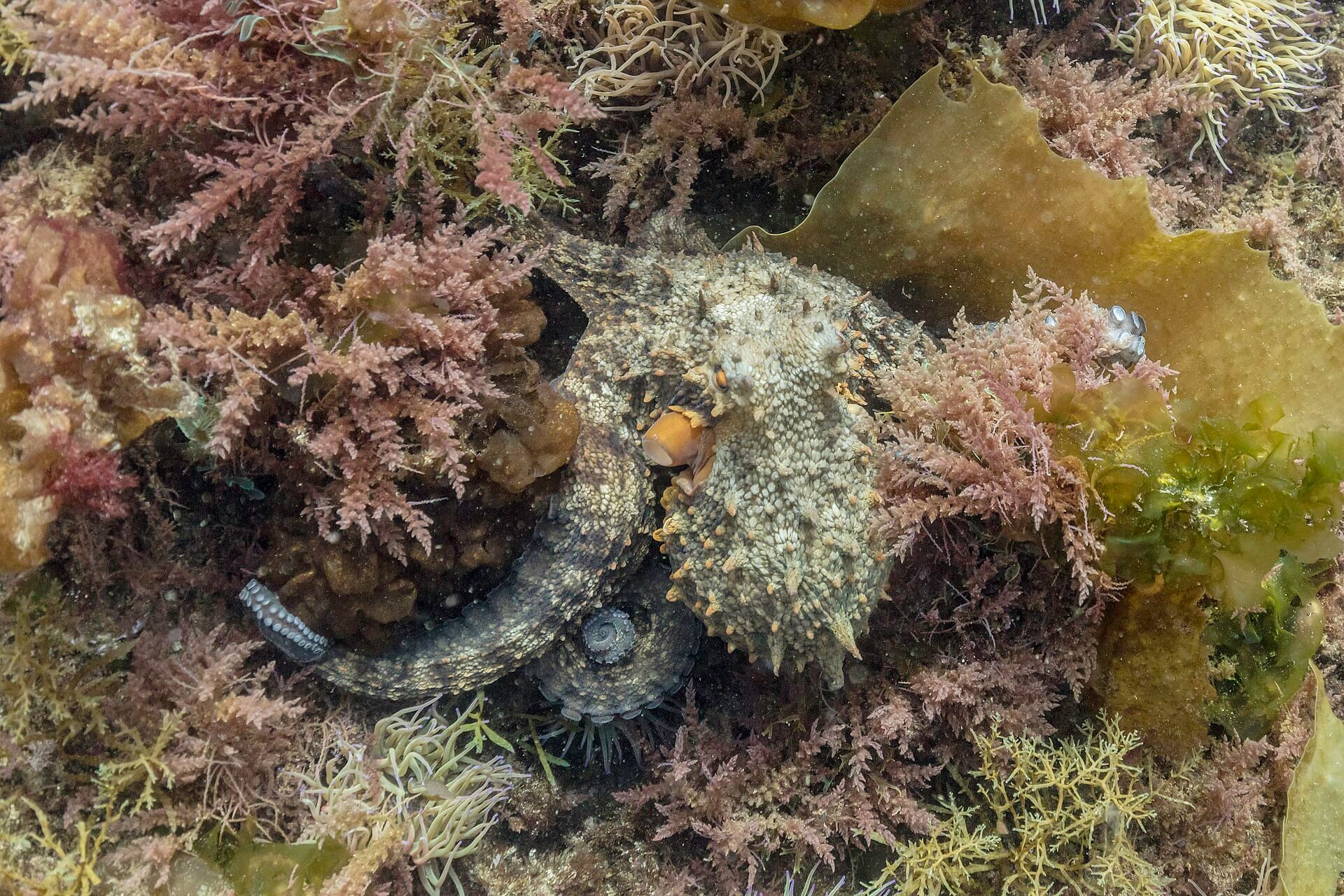
An octopus has eight arms, three hearts, blue blood and a body that can squeeze through any gap larger than its beak. Its nervous system is just as unusual. Much of its "thinking" happens not in the head but in the arms.
Where the neurons are
The common octopus has around 500 million neurons, a number comparable to some small mammals. According to a review by the neurobiologist Binyamin Hochner, published in Current Biology in 2012, about two-thirds of those neurons are in the arms. The central brain, wrapped around the esophagus, holds a smaller share.
Each arm has its own thick nerve cord running down its length, with clusters of neurons serving each sucker. A ring of nerves connects the arms to each other, so they can share information without going through the brain.
Arms that run their own programs
Experiments on octopus movement suggest that the brain sends fairly simple commands, such as "reach toward that," and the arm works out much of the detail itself. Reaching follows a stereotyped wave that travels along the arm, a motor program built into the arm's own nervous system.
This division of labor makes sense for an animal with eight flexible limbs and no skeleton. Controlling every point along every arm from the brain would be enormously demanding. Letting the arms handle the details frees the brain for other tasks.
Tasting by touch
Octopus suckers do more than grip. They are packed with sensory cells that detect touch and chemicals. In effect, an octopus can taste what it touches. As an arm explores a crevice in a reef, it can detect whether there is a crab hiding inside, sometimes before the octopus can see it.
Clever problem solvers
Octopuses have a reputation for intelligence, backed by many observations. In aquariums and experiments, they open screw-top jars, learn to navigate simple mazes and recognize individual people. In the wild, veined octopuses have been filmed carrying coconut shell halves and assembling them into shelters.
All of this comes from an animal that lives only a year or two and receives no parental teaching. Octopus mothers guard their eggs and usually die soon after they hatch.
A very different kind of mind
Octopuses are mollusks, related to snails and clams. Their last common ancestor with humans lived more than 500 million years ago and was probably a simple worm-like animal. Their complex brains and behavior evolved independently of ours.
That makes octopuses one of the best examples we have of a different route to intelligence, organized around a distributed body rather than a single control center.
Recognized as sentient
In 2021, a review led by researchers at the London School of Economics concluded that there was strong scientific evidence that octopuses and other cephalopods are sentient, meaning they can have feelings such as pain. As a result, the United Kingdom included cephalopods in its Animal Welfare (Sentience) Act 2022.
The next time you see an octopus exploring a rock pool, consider that each of those curling arms is, in its own way, paying attention.
Sources
- Hochner B. (2012). An embodied view of octopus neurobiology. Current Biology.
- UK Government (2022). Animal Welfare (Sentience) Act 2022.
Written by Your Name
Every claim in this article is checked against the published studies listed above. Found an error? Tell us and we will correct it.
Field fact
About two-thirds of a common octopus's neurons are in its arms, not its central brain.