Can tardigrades really survive anything?
Water bears have survived the vacuum of space, but they are not indestructible. How they endure extremes, and where the popular myths go too far.
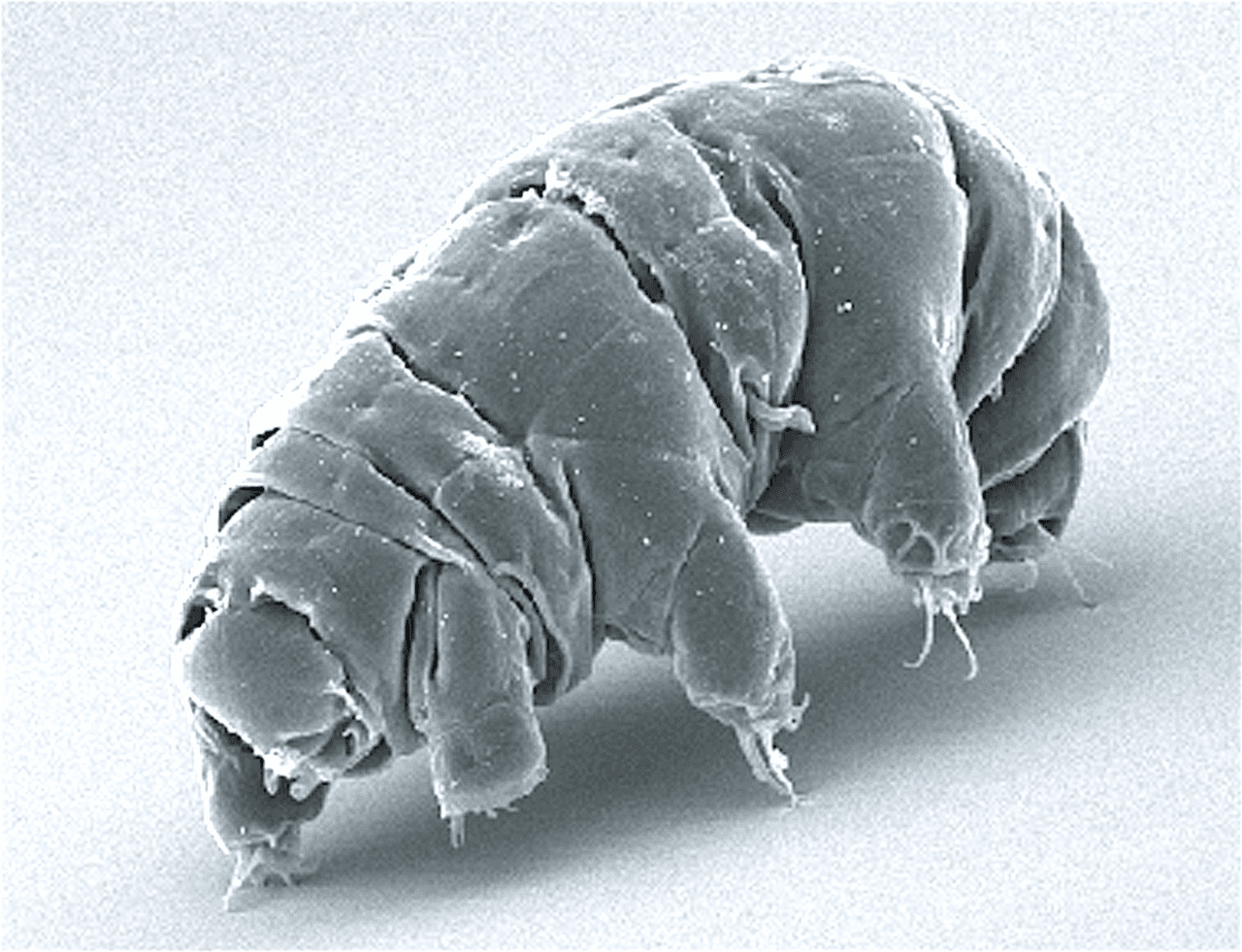
Tardigrades are small enough to go unnoticed but famous enough to have their own fan club. Often called water bears or moss piglets, these animals usually measure around half a millimeter long. They have eight stubby legs tipped with claws and amble through films of water on moss and lichen like tiny, slow bears.
They are often described as the toughest animals on Earth. Some of that reputation is earned. Some of it has been exaggerated.
Life in a drop of water
Tardigrades are aquatic animals in the sense that they need a film of water around them to be active. Many live in moss and lichen, which repeatedly dry out and get wet again. That cycle is the key to their famous toughness.
There are more than 1,300 known species, living everywhere from mountaintops to the deep sea. Not all of them are equally hardy. Much of the dramatic research has been done on a few species from habitats that regularly dry out.
The tun state
When its surroundings dry out, a tardigrade can enter a state called anhydrobiosis, meaning "life without water." It pulls in its legs and head, curls into a compact shape called a tun, and loses almost all of its body water, often around 95 percent or more. Its metabolism becomes almost undetectable.
In this state, a tardigrade can survive conditions that would kill it when active. When water returns, it can rehydrate and become active again, sometimes within minutes to hours.
How they protect themselves
Scientists are still working out exactly how tardigrades survive drying. Several mechanisms seem important:
- Protective proteins. In 2017, Thomas Boothby and colleagues described tardigrade-specific intrinsically disordered proteins that form a glass-like material as the animal dries. This may hold cell contents in place and prevent damage.
- Sugars. Some tardigrades produce trehalose, a sugar that protects cells during drying in many other organisms, although levels vary between species.
- DNA protection. A protein called Dsup ("damage suppressor"), found in the tardigrade Ramazzottius varieornatus, was shown in a 2016 study to reduce DNA damage from X-rays when it was added to human cells grown in the lab.
Tardigrades in space
In 2007, tardigrades in the tun state were sent into low Earth orbit on the FOTON-M3 mission and exposed to the vacuum of space. Many survived and reproduced after returning to Earth. Those also exposed to the full force of the Sun's ultraviolet radiation fared much worse, although a few still survived.
The result is real, but read it carefully: surviving space while dormant is not the same as living there.
Where the myths go too far
Popular articles sometimes claim tardigrades are "indestructible" or "immortal." They are neither.
- Active tardigrades are fragile. When hydrated and moving around, they are much more vulnerable to heat, chemicals and drying out too quickly.
- Heat is a weak point. A 2020 study by Ricardo Neves and colleagues found that active individuals of one species died after about a day at 37.1 °C. Tuns survived higher temperatures, but only for short periods.
- Drying must be gradual. If a tardigrade dries out too fast, it may not have time to enter a proper tun and can die.
- They have limited lifespans. Active life lasts months to a couple of years, depending on the species.
Find your own
You can find tardigrades with a simple microscope. Collect a small clump of dry moss, soak it in rainwater or bottled water for several hours, then squeeze the water into a shallow dish. Look at it under 20 to 40 times magnification. With patience, you may spot a water bear lumbering along. Return the moss outside when you finish.
Tardigrades don't need exaggeration to be amazing. A half-millimeter animal that can dry itself out, wait, and come back to life when the rain returns is extraordinary enough.
Sources
- Boothby T. C. et al. (2017). Tardigrades use intrinsically disordered proteins to survive desiccation. Molecular Cell.
- Hashimoto T. et al. (2016). Extremotolerant tardigrade genome and improved radiotolerance of human cultured cells by tardigrade-unique protein. Nature Communications.
- Jönsson K. I. et al. (2008). Tardigrades survive exposure to space in low Earth orbit. Current Biology.
- Neves R. C. et al. (2020). Thermotolerance experiments on active and desiccated states of Ramazzottius varieornatus emphasize that tardigrades are sensitive to high temperatures. Scientific Reports.
Written by Your Name
Every claim in this article is checked against the published studies listed above. Found an error? Tell us and we will correct it.
Field fact
Active tardigrades of one species died after about a day at 37 °C, roughly human body temperature.